

How to Improve Your Google Ranking: The Only SEO Checklist You Need
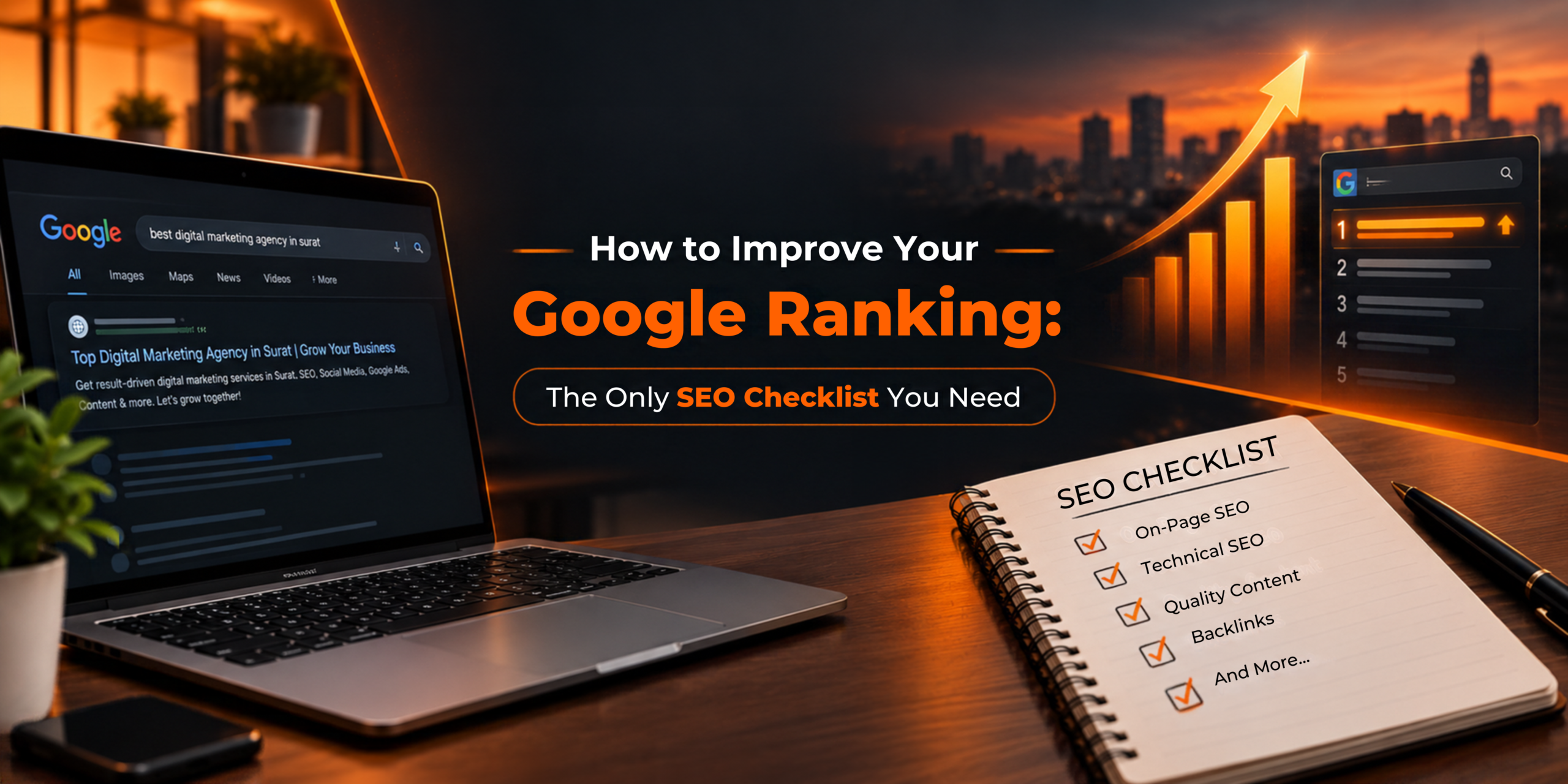
Imagine a diamond polisher in Varachha. He spends a year perfecting one stone. He knows it shines. But he keeps it in a drawer, so no buyer ever sees it.
Many websites are that drawer.
At Sunhariot iTech, we meet owners with a lovely site and zero enquiries. The stone is fine. The display window is missing. Google ranking is that window.
Below are ten moves that put your work under the light. Read them slowly. Start with the one that feels most urgent.
Four Lanes of Modern Search
People now find businesses in four ways:
- SEO: Your page appears in the normal Google search results.
- GEO (Generative Engine Optimization): AI chatbots name your brand in their replies.
- AEO (Answer Engine Optimization): Your answer is structured so search engines can use it for direct answers.
- AIO (AI Overview Optimization): Your content can become a useful source for Google's AI-generated summaries.
One clear, honest page can support all four search experiences when it provides useful information in a simple structure.
Move 1: Borrow Your Customer's Vocabulary
You may say "brand positioning." Your customer may type "how do I get more orders online." Same need, different words.
Here is how to find the language your customers actually use:
- Sit in on two sales calls and note repeated phrases.
- Review old WhatsApp chats, emails and customer questions.
- Type half a sentence into Google and check the suggestions.
- Give every important page one main search phrase.
Also ask what the person truly wants. Someone comparing a digital marketing company is often looking for clear services, proof and a reason to trust the business. Put useful answers on the page, and you address the real search intent.
Move 2: Give Every Page One Job
A page that tries to do five things often fails to do any of them clearly. Decide the single purpose of each page.
- One page should explain one main service or topic.
- The heading should clearly explain what the page offers.
- The first paragraph should introduce the main topic naturally.
- Every image should have useful, descriptive alt text.
- Each page should link to two or three genuinely related pages.
Read the page aloud. If the message feels confusing, your visitor may struggle with it too.
Move 3: Respect the Phone Screen
Many people browse websites from their phones while travelling, shopping or waiting in a queue. If your website is slow or difficult to use, they may leave before seeing what you offer.
Do a quick mobile health check:
- Open your five main pages on an ordinary smartphone.
- Check how quickly the pages load.
- Compress oversized images without hurting quality.
- Fix buttons and links that do not work.
- Remove duplicate or unnecessary pages.
- Make sure text and buttons are easy to read and tap.
Speed is not just a technical detail. It is part of the experience you give visitors.
Move 4: Build a Content Marketing Strategy
Publishing whenever you feel like it is like watering a plant once a month. A Content Marketing Strategy gives every article a purpose.
Keep it simple:
- Pick one reader and one major problem they face.
- Build a detailed hub page for each core service.
- Write supporting articles that answer related questions.
- Link supporting articles back to relevant service pages.
- Add your own client stories, examples, numbers and lessons.
- Review and update older content regularly.
Your real experience is an advantage. Another website can copy generic sentences, but it cannot easily copy your actual experience and results.
Move 5: Sell More with Ecommerce SEO
Run an online shop? Ecommerce SEO helps attract people who are already searching for products they may want to buy.
A common mistake is copying the supplier's product description. Hundreds of stores may then have nearly identical content.
Try this instead:
- Describe every product in your own words.
- Use clear and original product photographs.
- Display genuine ratings and reviews.
- Answer the most common customer questions.
- Show price, size, delivery information and return rules clearly.
- Create useful category and collection pages.
Picture a saree seller in Surat. Her fabric may be excellent. But if the product page hides delivery information or return rules, a buyer may choose another store that answers those questions immediately.
Move 6: Be the Nearest Trusted Name
Many searches include a location. Think about searches such as "seo agency near me" or "digital marketing agency in surat."
To strengthen your local presence:
- Claim and complete your Google Business Profile.
- Keep your business name, address and phone details consistent.
- Add genuine photos of your team, office and work.
- Ask satisfied customers for honest reviews.
- Respond professionally to customer reviews.
- Create useful location-specific pages where they genuinely help visitors.
When buyers compare an seo company in surat, they may look at reviews, services, location and website information before contacting a business. Treat every review as part of your online reputation.
Move 7: Practice Answer Engine Optimization
Answer Engine Optimization focuses on making useful information easy for search engines and answer systems to understand and present.
Make your content easier to understand:
- Write subheadings as real customer questions.
- Give a direct answer immediately below the question.
- Use numbered steps for how-to topics.
- Add a short FAQ section to important pages.
- Mention the author and relevant experience where appropriate.
- Keep important facts clear, specific and easy to verify.
Write like a knowledgeable expert explaining something over chai. Clear writing helps both people and search systems understand your message.
Move 8: Prepare for GEO and AIO
Generative search systems need clear information about businesses, services, products and topics. The easier your information is to understand, the easier it is for systems to connect your brand with the right subject.
- Describe your business consistently across important platforms.
- Support important claims with useful evidence.
- Earn genuine mentions from relevant industry websites.
- Keep statistics and business information updated.
- Use structured data where it is relevant and accurate.
- Make your organisation, services and expertise easy to identify.
Consistency helps search systems understand who you are, what you offer and which topics are connected to your business.
Move 9: Earn Trust Beyond Your Site
When another respected website mentions your business, it can introduce your brand to a new audience and strengthen your online presence.
Ways to earn genuine mentions include:
- Publish original research or useful industry insights.
- Write relevant guest articles for reputable websites.
- Share expert opinions with bloggers and industry publications.
- Join genuine business and industry directories.
- Create resources that other websites naturally want to reference.
Avoid buying large numbers of low-quality links. Focus on relevance, usefulness and genuine relationships instead.
Social Media Marketing can also support your wider digital presence. While social signals are not a direct Google ranking factor, social platforms can help distribute content, attract visitors and increase brand awareness.
- Share useful blogs on your active social channels.
- Turn important articles into short videos or carousels.
- Respond to relevant comments and questions.
Move 10: Turn Visits into Enquiries
Getting visitors is only one part of digital marketing. The next step is turning relevant traffic into enquiries and customers. The goal is to Generate Leads.
- Put one clear call-to-action on important pages.
- Keep enquiry forms short and simple.
- Place relevant reviews or trust signals near enquiry buttons.
- Add click-to-call and WhatsApp options for mobile visitors.
- Test different headlines and calls to action.
- Track calls, forms and other important conversions.
A small improvement in conversion rate can sometimes be more valuable than a large increase in traffic.
SEO grows over time. If you need additional enquiries while organic visibility develops, a Performance Marketing Agency can help manage paid campaigns. SEO and paid marketing can work together when they are planned around clear business goals.
Want to Learn It Yourself?
Search keeps changing, so learning never really stops. If you want to build these skills yourself, consider a practical Digital Marketing Course in Surat that includes live projects and practical assignments.
Doing real work can teach you how SEO, content, paid ads, analytics and social media work together in a real business environment.
Five Slips to Avoid
- Stuffing every keyword into one page.
- Copying content from other websites.
- Ignoring mobile users.
- Ignoring reviews and local business information.
- Stopping SEO after only a few weeks.
Your First Week
If everything feels overwhelming, start with a few practical tasks.
- Day 1: Complete your Google Business Profile.
- Day 2: Test your website on a mobile phone.
- Day 3: Review the headings on your five most important pages.
- Day 4: Add a useful Q&A section to your main service page.
- Day 5: Ask satisfied customers for genuine reviews.
Conclusion
Improving your Google ranking is not about one secret trick. It is a continuous process of creating useful content, improving technical performance, understanding search intent, building trust and measuring results.
Start with one important page. Fix what is missing. Add useful information. Improve the experience. Then move to the next page.
Sunhariot iTech is a growth-focused digital marketing company and digital marketing agency in surat, helping businesses improve their online presence through SEO, GEO, AEO, content marketing and paid advertising.
If your website is getting impressions but not enough clicks or enquiries, a structured SEO review can help identify where the gap is.
FAQs
Q1. How long does it take to improve Google ranking?
SEO results vary based on competition, website condition, content quality, authority and the search terms being targeted. Some changes can show movement within a few months, while competitive keywords may require longer, consistent work.
Q2. What is the difference between SEO, GEO, AEO and AIO?
SEO focuses on improving visibility in traditional search results. GEO focuses on visibility in generative AI experiences. AEO focuses on providing direct answers to user questions, while AIO relates to visibility within AI-generated search summaries.
Q3. Do I need separate pages for SEO, GEO, AEO and AIO?
Not necessarily. A well-structured page can support multiple search experiences when it contains accurate information, clear headings, direct answers, useful context and properly organized content.
Q4. Should I choose SEO or paid ads?
SEO and paid advertising serve different purposes. Paid ads can provide immediate visibility when campaigns are active, while SEO focuses on building organic visibility over time. Many businesses use both based on their goals and budget.
Q5. Can a small business improve its Google ranking against larger brands?
Yes, small businesses can focus on specific services, locations, customer questions and niche topics where they can provide highly relevant information. Strong local signals and genuine customer reviews can also support local visibility.
Q6. How often should I update my blog posts?
Review important posts every three to six months or whenever information changes. Update outdated statistics, broken links, examples, screenshots and recommendations so the content remains useful.
Q7. How do I choose the right SEO partner?
Look for relevant experience, clear reporting, realistic timelines, transparent processes and examples of previous work. Be careful with providers who guarantee specific Google rankings within an unrealistically short period.
Leave a Reply