

Top Ecommerce SEO Strategies to Increase Organic Traffic and Sales in 2026
What Does Ecommerce SEO Even Mean in 2026?
Ecommerce SEO still means one thing at its core: helping the right people find your store when they search for what you sell. It's the same core goal any good SEO company in Surat works toward, just applied to how buyers search today.
What's changed is where that search happens. It's no longer just Google's blue links. Today, e-commerce SEO covers three layers:
- Classic SEO - still ranking on Google, still matters, still the foundation.
- AEO, or Answer Engine Optimization - getting pulled into AI Overviews and chatbot answers.
- Technical and UX health - page speed, mobile usability, and structured data that machines can actually read.
Put simply: if your product pages don't answer questions clearly and quickly, a growing chunk of buyers will never even know you exist.
Why This Matters More Than It Ever Has
A few things are happening at once.
More than half of product research now starts with a search engine or an AI assistant. Many of those searches end without a click. This is called a zero-click search. The buyer gets an answer and never visits a website.
At the same time, more stores are competing for the same buyers than ever before. Ranking on page one isn't optional anymore. It's the line between growing and stalling.
We covered this shift in more detail in an earlier piece. Worth a read if you want the full picture.
Read More: Zero-Click Search in 2026 - What Marketers Must Know
AEO vs SEO: What's Actually Different?
This is probably the most-asked question we're hearing from clients right now, and rightly so. AEO vs SEO sounds like jargon, but the distinction changes how you write content.
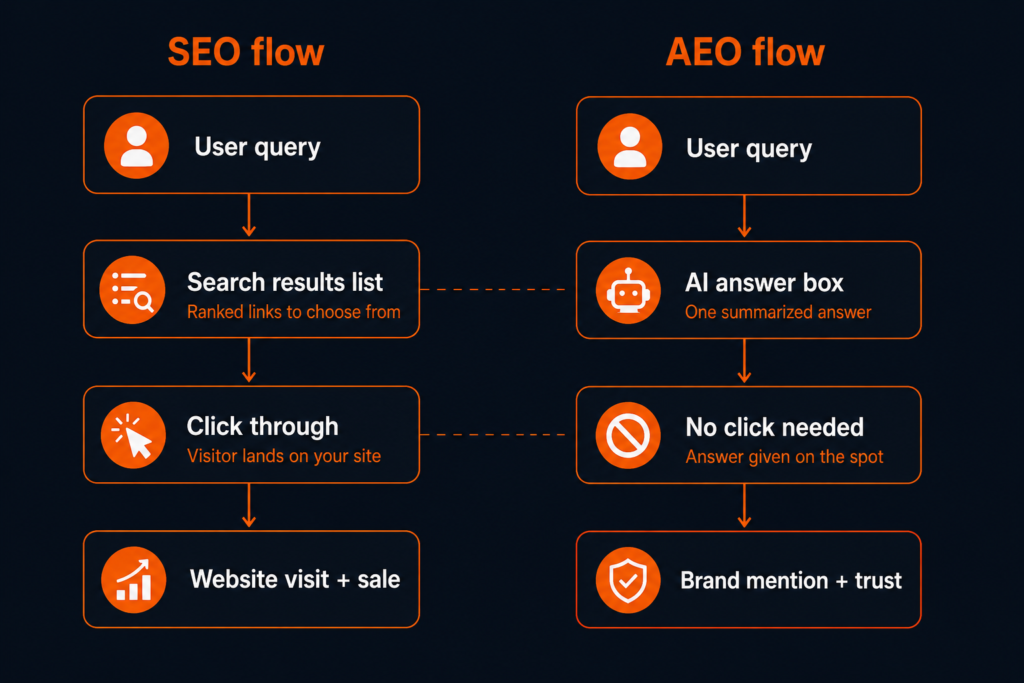
| Factor | SEO | AEO |
| What it's chasing | A ranking on the search results page | A spot as the direct answer inside an AI response |
| How content is built | Keyword-optimized, longer pages | Short, structured, answer-first chunks |
| What the user sees | A list of links to click | One summarized answer, no click needed |
| Writing style | Long-form, descriptive | Direct, FAQ-style, to the point |
| End result for you | A visitor lands on your site | Your brand gets mentioned, even without a visit |
Neither one replaces the other. SEO still drives long-term traffic. AEO keeps you visible even when someone never clicks a link. When you look at AEO vs SEO side by side, they're not competing strategies, they're two halves of the same visibility game. In 2026, ignoring either one costs you traffic.
The Ecommerce SEO Strategies Actually Worth Your Time in 2026
1. Stop Burying the Answer, Lead With It
Both AI models and Google reward pages that get to the point.
Compare these two openings for a product description:
Weak: "This product is amazing and loved by everyone."
Better: "This cotton kurti is made from a breathable, machine-washable fabric designed for daily wear in humid weather."
The second one actually tells you something. That's the bar now, every product page should open with a real, factual answer to "what is this, and who's it for," not a vague compliment.
2. Write Headings the Way People Actually Ask Questions
Think about how someone talks to ChatGPT versus how they used to type into Google. It's more conversational now. Your headings should match that:
- What is the best material for summer wear?
- Is this product suitable for everyday use?
- How long does this actually last?
- Is it worth buying in 2026?
These aren't just SEO-friendly, they mirror the exact phrasing AI tools are trained to recognize and extract answers from.
3. Make Sure AI Can Tell What Your Product Actually Is
Search engines and AI models don't just match keywords anymore, they connect entities. That means your pages need to clearly and naturally include things like:
- Your brand name
- The product category
- Material, size, or spec details
- The occasion or use case it fits
It sounds basic, but a surprising number of product pages skip this. Without it, AI has no reliable way to understand "who's selling what, for whom."
4. Comparisons Are Doing a Lot of Heavy Lifting Right Now
If there's one content format punching above its weight in 2026, it's comparisons. People search "X vs Y" constantly, and AI tools love extracting from tables and clean bullet lists because the structure does half the work for them.
A few formats worth building:
- Product A vs Product B
- Cotton vs Linen
- Budget range vs Premium range
Don't overthink the design, a simple table beats a paragraph explaining the same thing every time.
5. Fix the Technical Stuff Before You Write Another Word
None of the content strategy above matters if your store is technically broken underneath it. Before you invest more in blogs or product copy, check:
- Mobile load time under 3 seconds, no exceptions.
- Clean, readable URLs for categories and products.
- Schema markup for Product, Review, FAQ, and Breadcrumb data.
- Duplicate content across product variants.
- HTTPS and a secure checkout across the whole site.
6. Write for How People Actually Talk, Not How Keywords Used to Work
Nobody types "running shoes" into a voice assistant. They say "what's a good affordable running shoe for everyday wear." Long-tail, conversational phrases are outperforming short generic keywords, and that gap is only growing.
7. Connect Your Pages to Each Other
A strong internal linking structure does three things at once, it helps search engines crawl your catalog properly, it keeps shoppers browsing instead of bouncing, and it spreads ranking authority across your store instead of trapping it on one or two pages.
8. Help People Decide, Not Just Browse
Some of the best-performing e-commerce content isn't a product page at all, it's a buying guide. Sections like these consistently perform well because they mirror how people actually make decisions:
- Who should buy this?
- Who should probably skip it?
- Best for daily use vs. occasional use
- Is it worth it long-term?
9. Add a Real FAQ Section, Not an Afterthought
This is one of the highest-leverage tactics for AEO visibility right now. Aim for 5 to 10 natural-sounding questions, each answered in one to three lines. Short, direct, no fluff. AI tools pull from these constantly.
10. Let Social Media and SEO Actually Talk to Each Other
Too many stores still treat SEO and social media as separate departments with separate goals. That's a mistake in 2026. Good social media marketing services feed directly into your SEO performance by:
- Driving branded search volume, which search engines read as a trust signal.
- Generating natural backlinks and mentions through creator or influencer collaborations.
- Producing shareable content that AI systems reference when judging credibility.
- Reinforcing the brand recognition that both Google and AI answer engines lean on.
A store that shows up consistently on social platforms builds exactly the kind of authority that search algorithms and AI systems are designed to reward.
11. Build Trust Signals That Actually Hold Up
Both search engines and AI systems are getting better at spotting credibility, or the lack of it. Make sure you have:
- Genuine, unedited customer reviews.
- Clear shipping, return, and warranty policies.
- Real author or brand information behind your blog content.
- Honest, specific product specifications, not vague marketing language.
12. Track More Than Just Your Rankings
Traditional rank tracking only tells half the story now. You also need to know whether your content is showing up inside AI-generated answers, and if it's not, that's a signal to restructure the content, not just add more keywords.
How AI Search Is Quietly Changing the Way People Buy
Buyer behavior has shifted more in the last two years than in the previous ten. People aren't typing short keywords into Google and scrolling anymore, they're asking full, natural questions to AI assistants and expecting a straight answer back.
That shift changes three things for e-commerce specifically:
Research now happens before the click. A shopper might already know exactly which product fits their needs before they ever land on your site, because an AI assistant already summarized the comparison for them.
Trust gets built at the answer stage, not the landing page. If your brand isn't part of that AI-generated summary, a competitor's brand probably is, and that's often what tips the decision.
And when someone does click through, they expect the page to confirm what the AI already told them. Generic marketing copy that doesn't match what they just read feels off, and they bounce.
The takeaway? Your pages need to be written to be quoted, not just ranked.
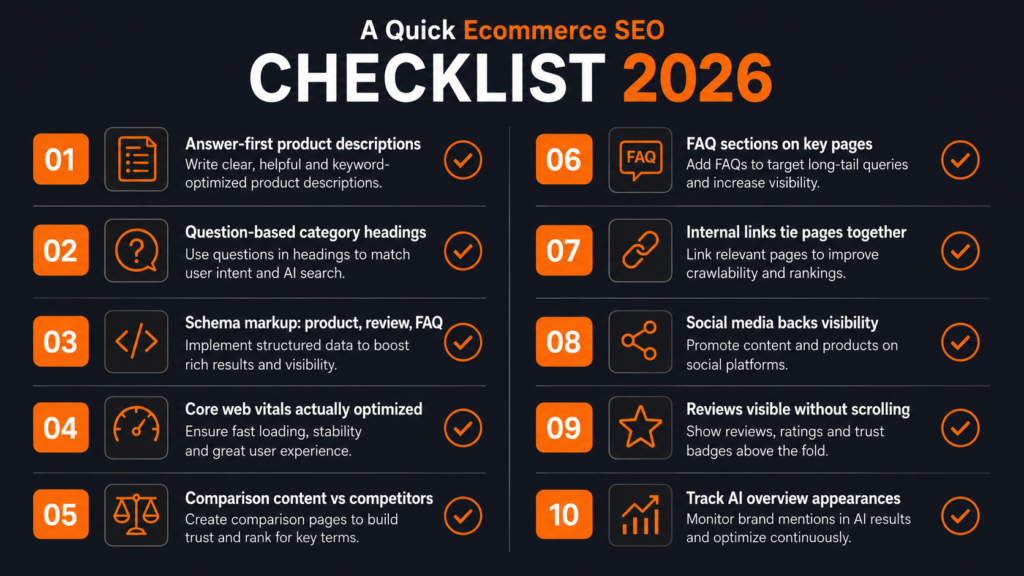
A Quick Ecommerce SEO Checklist for 2026
Worth running your store through this before you do anything else:
- Every product page opens with a direct, factual, answer-first description.
- Category pages use question-based headings.
- Schema markup is in place for Product, Review, FAQ, and Breadcrumb.
- Core Web Vitals and mobile speed are actually optimized, not just "fine."
- Comparison content exists for your top competing products.
- FAQ sections appear on major landing and product pages.
- Internal links connect your guides, categories, and products.
- Social media marketing services are actively supporting brand visibility.
- Reviews and trust signals are visible without scrolling.
- You're tracking AI overview appearances, not just keyword rankings.
Missing three or four of these? You're likely losing traffic to a competitor who already fixed them.
Mistakes That Quietly Hold Ecommerce Stores Back
Even well-established brands fall into these traps:
- Writing for keywords instead of intent. Stuffing a page with repeated phrases instead of actually answering what the buyer wants to know.
- Copy-pasting the same description across every color or size variant, which confuses search engines about what's actually unique.
- Skipping structured data entirely, which leaves AI systems guessing at basic product details.
- Running SEO and social media as two disconnected teams with two disconnected strategies, which just wastes budget.
- Publishing a page once and never touching it again, even as prices, trends, or specs change.
- Ignoring local search intent altogether. Plenty of e-commerce brands with a real office or warehouse never bother optimizing for searches like "digital marketing agency in Surat" or "SEO company in Surat," even though that's exactly how nearby business buyers find them.
Choosing the Right SEO Partner
Not every agency has actually adapted to the AEO shift, a lot are still selling 2022-era SEO with a new coat of paint. When you're evaluating a digital marketing agency in Surat or an SEO company in Surat, look for a few specific things:
A real technical SEO audit process, not just a keyword report with a nice cover page. Actual experience implementing schema markup and structured content. A content strategy that includes FAQs, comparisons, and buying guides, not just blog posts for the sake of blog posts. Social media marketing services that are genuinely integrated into the SEO strategy, not bolted on separately. And reporting that's honest about both search rankings and AI visibility, not just vanity metrics.
If an agency can't explain in plain language how their approach adapts to AEO alongside traditional SEO, that's worth noting before you sign anything.
Conclusion
Ecommerce SEO in 2026 isn't just about ranking on Google anymore. It's about being the answer AI tools choose to show, while still building a technically solid, genuinely trustworthy store that turns visitors into customers once they actually click through.
The strategies above, answer-first content, question-based headings, comparison blocks, technical fixes, and social media working in tandem with SEO, don't perform in isolation. They work because they reinforce each other.
If you'd rather have a team that already understands both traditional SEO and the AEO shift, that's exactly where Sunhariot iTech comes in. From technical audits to content strategy to social media marketing services, it's built to help e-commerce brands hold onto organic visibility that actually lasts, not just spike for a month and fade.
FAQs: Ecommerce SEO in 2026
Q1. What's the single most important ecommerce SEO strategy right now?
Answer-first, well-structured content paired with solid technical SEO. Without both, nothing else performs as well as it should.Q2. What's the real difference between AEO and SEO?
SEO is about ranking your page in search results. AEO is about getting your content picked as the actual answer inside tools like ChatGPT or Google's AI Overviews.Q3. Do I still need social media marketing if I'm already doing SEO?
Yes, social media marketing services build the brand signals and trust indicators that quietly strengthen your SEO performance, even though they're technically separate channels.Q4. How long before e-commerce SEO actually shows results?
Most stores start seeing real movement in organic traffic within 3 to 6 months, with the biggest gains compounding over the following year.Q5. Should I hire a digital marketing agency in Surat, or handle SEO myself?
If you don't have dedicated technical and content resources in-house, a solid digital marketing agency in Surat will usually get you there faster and help you avoid expensive missteps.Q6. What does an SEO company in Surat actually do day to day?
A good one audits your technical SEO, optimizes your product and category pages, builds out a content strategy, and tracks both traditional rankings and AI visibility over time.Q7. Is zero-click search actually a threat to e-commerce SEO?
It changes the game more than it kills it. You still need to show up inside AI-generated answers, while also giving people a reason to click through for the ones ready to buy.Q8. Can a small e-commerce store realistically compete with bigger brands?
Yes, long-tail keywords, niche content, and local targeting tend to be far less competitive than broad national terms, which levels the playing field more than people expect.Q9. Why does schema markup matter so much?
It gives search engines and AI systems a clean, structured way to understand your product's name, price, availability, and reviews, which directly improves your odds of showing up in rich results or AI overviews.Q10. What's the actual difference between on-page and technical SEO?
On-page SEO covers the content, headings, and keywords on a specific page. Technical SEO covers the underlying stuff, site speed, crawlability, mobile performance, and structured data across your entire store.Q11. How often should e-commerce content be refreshed?
Every 3 to 4 months is a reasonable rhythm, especially whenever prices, specs, or trends shift enough to make older content inaccurate.Q12. Does social media activity directly boost Google rankings?
Not as a direct ranking factor, no, but it builds the brand mentions, traffic, and trust signals that indirectly support both SEO and AI visibility.Q13. How much do customer reviews actually matter for SEO?
More than most stores realize. Reviews are a core trust signal that both search engines and AI systems use to judge credibility, and they're often pulled directly into AI-generated answers.Q14. Does local SEO matter for a store that only sells online?
Less than it would for a local business, but if you have a physical office or warehouse, it still helps you show up for searches tied to your city or service area.Q15. Where is AEO headed after 2026?
It's likely to become fully baked into core SEO rather than treated as a separate trend, as AI-powered search interfaces keep growing. Structured, answer-first content is probably going from "nice to have" to "expected."Leave a Reply