

Why Answer Engine Optimization Is the Smart Choice for Businesses in 2026
Search behavior has shifted from typing keywords into Google to asking plain-language questions on tools like ChatGPT, Gemini, and AI Overviews, expecting one direct answer instantly making Answer Engine Optimization (AEO) essential heading into 2026, now as important as traditional SEO, since brands still relying only on keyword stuffing and backlinks are likely already losing customers to faster-moving competitors; this piece covers what AEO is, why it matters now, how it differs from SEO, and how Sunhariot iTech, a trusted digital marketing agency in Surat, can help implement it for your business.
What Is Answer Engine Optimization (AEO)?
AEO focuses on structuring content so AI systems can understand and deliver it as a direct answer, unlike SEO which just chases page rankings AEO aims to become the answer itself, whether in an AI overview, chatbot reply, or voice search response, since ranking gets you found but AEO gets you spoken; as search platforms increasingly read and condense content to answer questions directly, driving the rise of zero click searches, pages that AI struggles to understand get left out entirely, regardless of their ranking position.
Why AEO Matters More Than Ever in 2026
Why Instant Answers Are Taking Over
A major force behind AEO's rise is the sharp jump in zero click searches search sessions where the user's question gets resolved right there on the results page, with no visit to any website whatsoever.
Several trends are driving this pattern:
- Google now resolves most everyday factual questions instantly through AI overviews.
- Voice assistants speak back a single answer instead of reading out a list of web links.
- ChatGPT, Gemini, and similar tools synthesize material from many sources into one combined reply.
- On phones especially, people lean toward the fastest possible answer rather than open browsing.
- Smart speakers and in-car voice systems are turning into routine ways of asking questions.
A page can hold a solid ranking and still lose traffic, purely because the visitor's question got answered before they ever reached the results list. Content not built to serve as that answer gets passed over, while a competitor's page might end up being the one an AI assistant reads aloud instead.
This isn't a temporary blip in numbers. It's a permanent change in how people search for things.
AI Has Become the First Stop
More and more customers now put questions like "which is the best SEO company in Surat" straight to an AI chatbot before they've opened a single website. If content isn't written for an AI system to extract cleanly, it simply won't be part of the answer that gets returned regardless of how strong the actual service behind it might be.
This rewires the entire buying journey. In the older model, a customer would search, browse a handful of sites, compare notes, and pick one. Now, the AI often does that comparison itself and names just one or two businesses by name. Miss that shortlist, and the customer is gone before your site ever loads.
Credibility Gets Decided Before the Click
Since AI tools blend information gathered from multiple places into a single reply, whichever business name comes up first tends to feel more trustworthy to the person reading it. That's what makes getting ahead on AEO a genuine competitive edge, not just a box-checking exercise.
How AEO Is Different From Traditional SEO
| Factor | Traditional SEO | Answer Engine Optimization (AEO) |
|---|---|---|
| Main Goal | Earn a place in the results list | Become the answer that gets picked |
| Content Style | Long, keyword-heavy paragraphs | Short, plain, answer-first sections |
| Format | Blog-style narrative writing | Question-led, FAQ-style structure |
| Success Metric | Click-through rate | Answer visibility and brand mentions |
| Search Behavior | User clicks through and explores | User gets an answer without a click |
| Best For | Growing authority slowly over time | Winning trust and answers quickly |
| Content Length | Frequently long and in-depth | Compact and quick to scan |
| Technical Focus | Backlinks, domain authority | Structured data, clear entity signals |
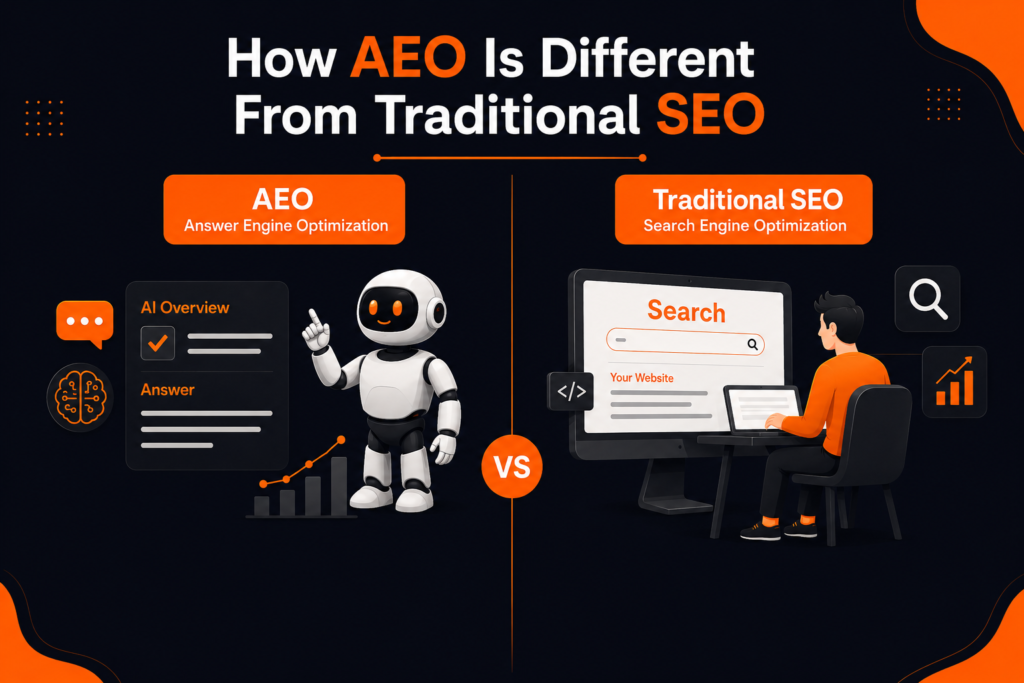
SEO and AEO aren't rivals; they support one another. AEO sits on top of a solid SEO base rather than replacing it. A page that already performs well in traditional search gives AI tools a stronger foundation to pull a trustworthy answer from. Businesses running these two efforts as separate silos tend to lag behind the ones treating them as a single strategy.
Is AEO Worth It for Your Business in 2026?
Yes, AEO is worth it for most businesses in 2026 especially if your customers are already asking AI tools like ChatGPT, Gemini, or Google AI Overviews before visiting any website.
Here's a quick way to decide if it's worth it for your business:
AEO is worth it if you:
- Rely on Google or AI search for new customer inquiries.
- Compete in a crowded niche (like digital marketing, healthcare, or local services).
- Already have website content but it's written in long, unstructured paragraphs.
- Want to build long-term trust and brand recall in AI-generated answers.
AEO may not be worth prioritizing yet if you:
- Don't have a website or any published content.
- Rely entirely on offline referrals with no online customer search behavior.
- Are looking for overnight results without ongoing content updates.
The real cost of skipping AEO
A business can hold a decent Google ranking and still lose the customer, simply because an AI assistant answered the question using a competitor's content instead. That's the actual risk of ignoring AEO in 2026 not lower rankings, but disappearing from the answer itself.
The bottom line
AEO doesn't replace your existing SEO work it builds on it. If SEO is already part of your strategy, adding AEO is a low-cost, high-value extension that positions your business to be the answer AI tools give, not just another link on the results page.
Key Benefits of Answer Engine Optimization
1. Stronger Presence Inside AI Search Results
Content that's organized cleanly stands a far better chance of getting pulled into an AI-generated reply, putting your business name in front of a customer before any competitor even shows up.
2. Trust and Authority Build Faster
AI systems tend to favor material that states facts plainly and demonstrates real expertise the same qualities search engines have long grouped under Experience, Expertise, Authoritativeness, and Trustworthiness, commonly shortened to E-E-A-T.
3. Better Performance in Voice Search
Voice assistants read back one short, direct answer at a time. AEO-friendly writing tends to do better with spoken queries such as "who offers the best social media marketing services near me.
4. A Better Experience for Real Readers
Short, clearly chunked content isn't only useful to AI human readers find it easier to follow too, which usually means fewer people bouncing off the page early.
5. A Competitive Lead That Sticks
Companies that get moving on AEO early stand a good chance of owning AI-generated answers before rivals even notice the shift, much like the early SEO adopters did years earlier.
6. Deeper Brand Recall
Every time an AI tool repeats a business name as the answer to a common question, that name sticks a little harder in someone's memory, even for people who never actually click through to the site.
7. Closer Alignment With Real Search Behavior
Actual questions read conversationally closer to "which is the best digital marketing agency in Surat for a small business" than a bare fragment like "digital marketing agency Surat." AEO-style writing naturally leans into that conversational rhythm.
How to Optimize Your Website for AI Answer Engines
Lead Every Section With the Answer
Open with a direct, plain answer rather than easing in with a long preamble.
Weaker: "Our agency has been helping businesses grow online for a long time and we really care about results."
Stronger: "A results-driven digital marketing agency in Surat helps businesses grow traffic, leads, and sales through SEO, social media, and paid advertising."
Turn Headings Into Real Questions
Structure content around the exact kinds of questions people put to AI tools, such as:
- What is Answer Engine Optimization?
- How is AEO different from SEO?
- Is AEO worth it for small businesses?
- How does AI-driven search affect website traffic?
- Which is the best SEO company in Surat for AEO-ready content?
Build In Comparison Sections
AI tools frequently pull from comparison-style material because it settles a "which one wins" question directly. A table like the SEO-versus-AEO one above does this job especially well.
Keep Everything in Small, Digestible Pieces
Skip the dense, sprawling paragraph. Rely instead on:
- Two to three line paragraphs.
- Bullet points for anything list-shaped.
- A distinct subheading for every fresh idea.
- Just one main point per paragraph.
Bring In Genuine Trust Signals
Give real specifics the exact services offered, years in business, physical location, and actual results delivered. Broad, unproven claims rarely get chosen as trustworthy answers.
Put an FAQ Block on Every Important Page
FAQs remain one of the sharpest tools for AEO, simply because they echo the exact phrasing people use when talking to an AI assistant.
Layer In Structured Data and Schema Markup
Add FAQ schema, article schema, and local business schema across your key pages. This gives AI crawlers an easier time reading the content and raises the odds of showing up inside an answer box.
Keep Content Fresh
AI systems favor current, accurate information. Old statistics, outdated pricing, or expired offers quietly lower a page's odds of being treated as a dependable source.
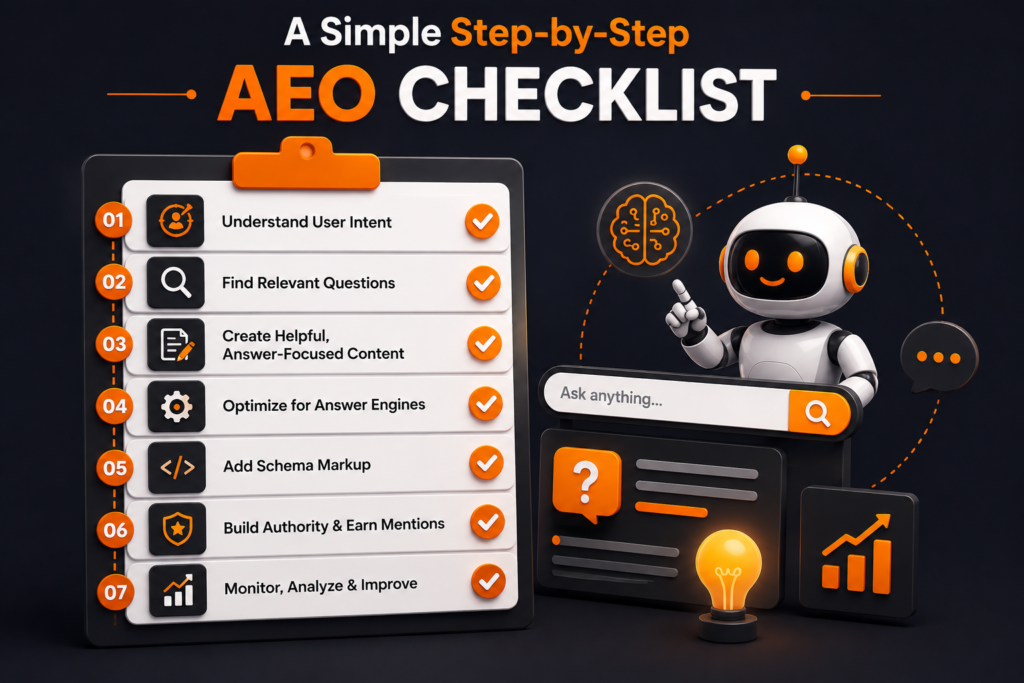
A Simple Step-by-Step AEO Checklist
Here's a practical sequence for getting started:
- Take stock of what's already published - flag pages built around long, unstructured paragraphs.
- Pull real customer language - gather actual phrasing from search data, emails, and past sales calls.
- Rebuild key pages to open with the answer - move the direct answer up to the very first line.
- Grow FAQ sections - aim for six to ten questions per important page, each kept to a few lines.
- Add comparison tables - anywhere a decision needs to be made, lay it out side by side.
- Set up schema markup - apply FAQ and article schema to the pages that matter most.
- Tighten local details - state the city and service area clearly and repeatedly.
- Track AI visibility over time - watch whether the brand appears in AI Overviews or chatbot answers for target queries.
- Come back to it quarterly - refresh numbers, examples, and offers on a regular schedule.
This order works whether it's handled internally or passed to a specialist team.
Common Mistakes Businesses Make With AEO
- Burying the actual answer deep inside a long paragraph instead of leading with it.
- Skipping FAQ sections entirely, despite them being one of the simplest wins going.
- Leaving out local details, like the city name or service area.
- Leaning on vague claims such as "best in the industry" without anything to back them up.
- Treating AEO as a single one-off project instead of an ongoing habit.
- Skipping schema markup, which makes it harder for AI systems to parse a page properly.
- Leaning too heavily on competitor content instead of writing something original.
Avoiding just these few missteps can put a business ahead of a large share of competitors still writing purely for traditional SEO.
Where SEO, Social Media, and AEO Fit Together
AEO rarely delivers much value sitting on its own. It performs best as part of a broader, well-rounded online presence:
- A SEO company in Surat helps set up the technical and content groundwork that AI tools come to trust over time.
- Social media marketing services keep a brand consistently visible and mentioned across platforms, which strengthens how AI systems recognize that brand.
- Answer-first blog writing feeds naturally into AI Overviews and chatbot responses.
- Regular mentions across directories, reviews, and social platforms act as extra trust signals AI tools rely on verifying credibility.
Businesses treating SEO, social media, and AEO as one connected plan rather than three separate tasks tend to see the strongest results heading into 2026. A single, well-built blog post can serve all three goals at once: ranking in traditional search, appearing inside AI answers, and being worth sharing on social platforms.
Read More: Top Digital Marketing Tips for Small Businesses in 2026
Industry-Wise AEO Opportunities
For Local Service Businesses
Restaurants, salons, clinics, and repair shops gain a lot from AEO, since most of their customer questions revolve around location. "Near me" style searches are exactly what AI tools tend to answer directly.
For E-Commerce Brands
Product comparisons, sizing guides, and usage-focused FAQs are precisely the kind of structured content AI tools favor when handling shopping-related questions.
For B2B and Professional Services
Buyers here tend to research heavily before ever picking up the phone. Answer-first content walking through process, pricing, and comparisons builds trust well before a sales conversation begins.
For Agencies and Consultants
Since trust drives most decisions in service-based fields, clear FAQs, transparent processes, and specific results help agencies get recommended by AI tools ahead of vaguer competitors.
AEO Trends to Watch in 2026
- AI Overviews keep spreading into more search categories, eating further into organic clicks.
- Voice commerce keeps building momentum, letting people finish purchases through spoken answers alone.
- Schema markup shifts from optional to close to essential, since it helps AI tools read pages faster.
- More "near me" and city-specific searches get answered directly by AI rather than through a list of links.
- The same content increasingly has to perform across Google, ChatGPT, and voice assistants all at once.
- Search queries are blending images, voice, and text together more often, rather than sticking to one format.
- AI tools keep getting better at filtering out copied or low-effort material, so originality matters more.
Businesses that stay ahead of these shifts now will hold a real edge as AI-driven search keeps expanding.
Conclusion
Answer Engine Optimization isn't a passing fad it reflects how people genuinely search for things in 2026. As AI-driven search keeps climbing and AI tools increasingly become the first stop for customer questions, businesses that don't adapt risk fading into the background, even with a website that ranks reasonably well.
The smart path forward is straightforward: pair solid SEO fundamentals with active social media marketing services and clear, answer-first content built for AI. Whether that work happens in-house or through a trusted digital marketing agency in Surat like Sunhariot iTech, the businesses investing in AEO now will be the ones AI tools recommend tomorrow.
FAQs For Why Answer Engine Optimization Is the Smart Choice for Businesses in 2026
Q1. What is Answer Engine Optimization (AEO)?
AEO is the practice of shaping website content so AI search tools and voice assistants can extract it directly as an accurate, ready-made answer.
Q2. How is AEO different from SEO?
SEO aims to rank within the search results, while AEO aims to be chosen as the direct answer inside AI Overviews, chatbots, and voice search.
Q3. Why does AI-driven search matter for businesses?
It means users get their answer without ever opening a website. Content that isn't AEO-ready loses visibility even while technically ranking fine.
Q4. Does AEO replace traditional SEO?
No. The two work together. A solid SEO foundation makes it easier for AI tools to find and trust the content in the first place.
Q5. Do small businesses actually benefit from AEO?
Yes, local ones especially, since AI tools get used constantly for "best near me" and other service-related searches.
Q6. What kind of content works best for AEO?
Short, clear, answer-first content tends to perform best question-led headings, bullet points, comparison tables, and FAQ sections all help.
Q7. Is hiring a digital marketing agency worth it for AEO?
For businesses short on time or the know-how to restructure content properly, a digital marketing agency in Surat can help get AEO in place faster and more accurately.
Q8. Does voice search fall under AEO?
Yes. Voice search optimization sits right at the core of AEO, since assistants speak back short, direct answers pulled from well-structured content.
Q9. How long does it take to see results from AEO?
Most businesses start noticing early signs, such as appearing inside AI Overviews or chatbot answers, within a few weeks of restructuring key pages, though building consistent visibility usually takes a few months of steady effort.
Q10. Does schema markup actually make a difference for AEO?
Yes. FAQ, article, and local business schema help AI crawlers understand a page's structure and context faster, which improves the odds of that content being pulled into an AI-generated answer.
Q11. Can AEO help a business rank for "near me" searches?
Yes. Since AEO focuses on clear local details, service areas, and answer-first content, it directly supports the kind of location-based queries AI tools handle most often.
Q12. What happens if a business ignores AEO in 2026?
Its content risks getting left out of AI Overviews, chatbot replies, and voice search answers altogether, even if the page still holds a decent position in traditional search rankings.
Q13. Is AEO only useful for large businesses with big budgets?
No. AEO works well for small and local businesses too, since it relies more on clear, well-structured content than on expensive advertising or large-scale campaigns.
Q14. How often should AEO content be updated?
Key pages should be reviewed and refreshed roughly every quarter, updating statistics, examples, and offers so the content stays accurate enough for AI tools to keep trusting it.
Q15. Does social media activity support AEO efforts?
Yes. Regular mentions and consistent activity across social platforms act as trust signals that help AI systems recognize and verify a brand more confidently.
Leave a Reply